
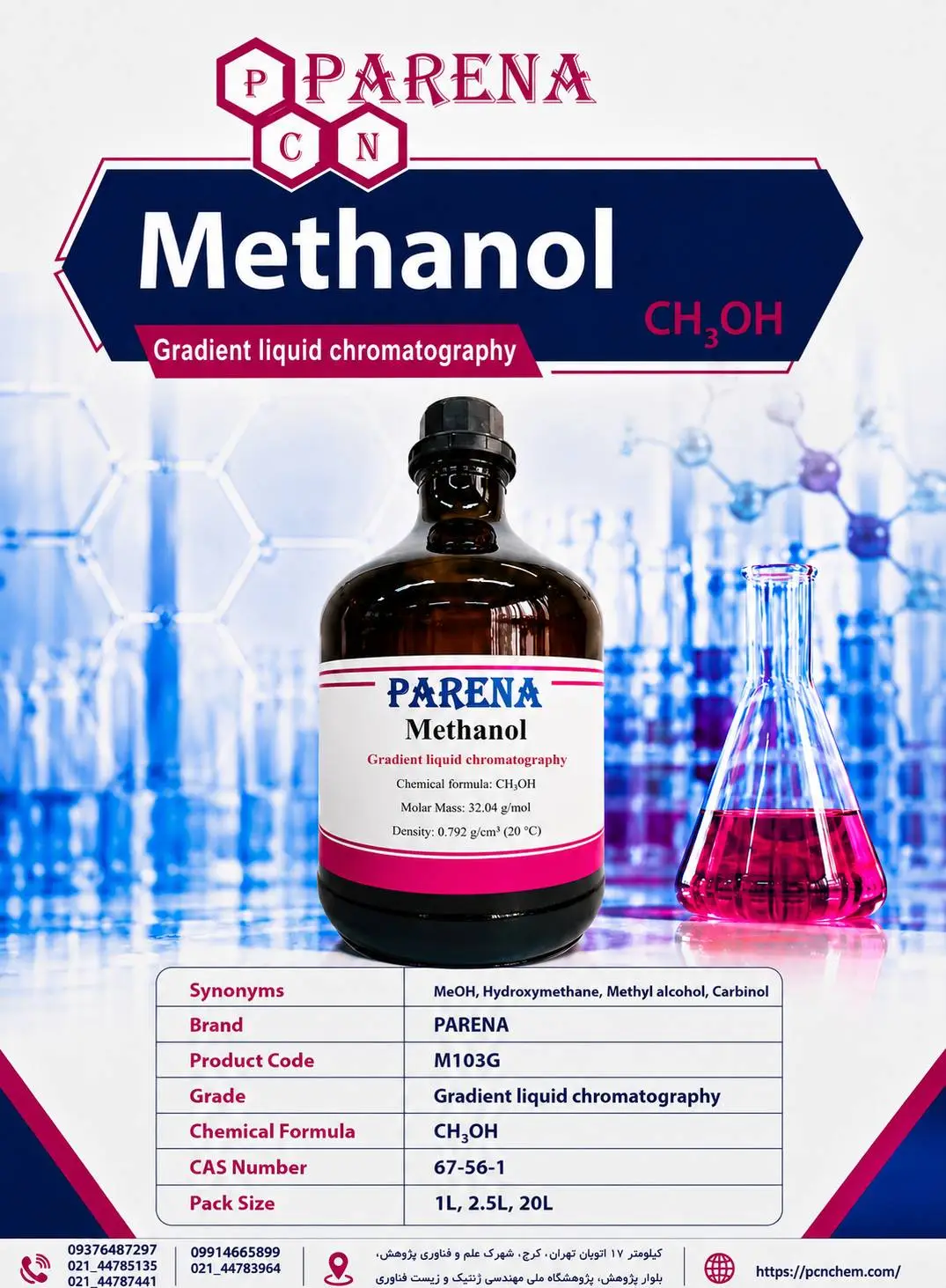
Methanol for Gradient Liquid Chromatography | PARENA Brand | Product Code M103G
Methanol Gradient HPLC by PARENA is an organic solvent with the chemical formula CH₃OH and CAS Number 67-56-1, designed for use in High-Performance Liquid Chromatography (HPLC) methods. It is used for mobile phase preparation, chromatographic method development, analysis of organic compounds, and the implementation of isocratic and gradient elution methods.
In liquid chromatography, the quality of an organic solvent is not evaluated solely by its chemical purity percentage. UV absorbance, trace organic impurities, non-volatile residue, water content, and solvent behavior during gradient elution tests are also important parameters affecting analytical performance. These characteristics are particularly important in methods using UV or DAD detectors, where the mobile phase composition changes over time.
Methanol Gradient HPLC Grade is used as the organic mobile phase component alongside water or aqueous buffer solutions. By changing the proportion of organic solvent throughout the chromatographic program, it enables adjustment of mobile phase elution strength, modification of retention times, and improvement of separation between compounds with different physicochemical properties.
This product is supplied under the PARENA brand, product code M103G, in 1 L, 2.5 L, and 20 L packaging.
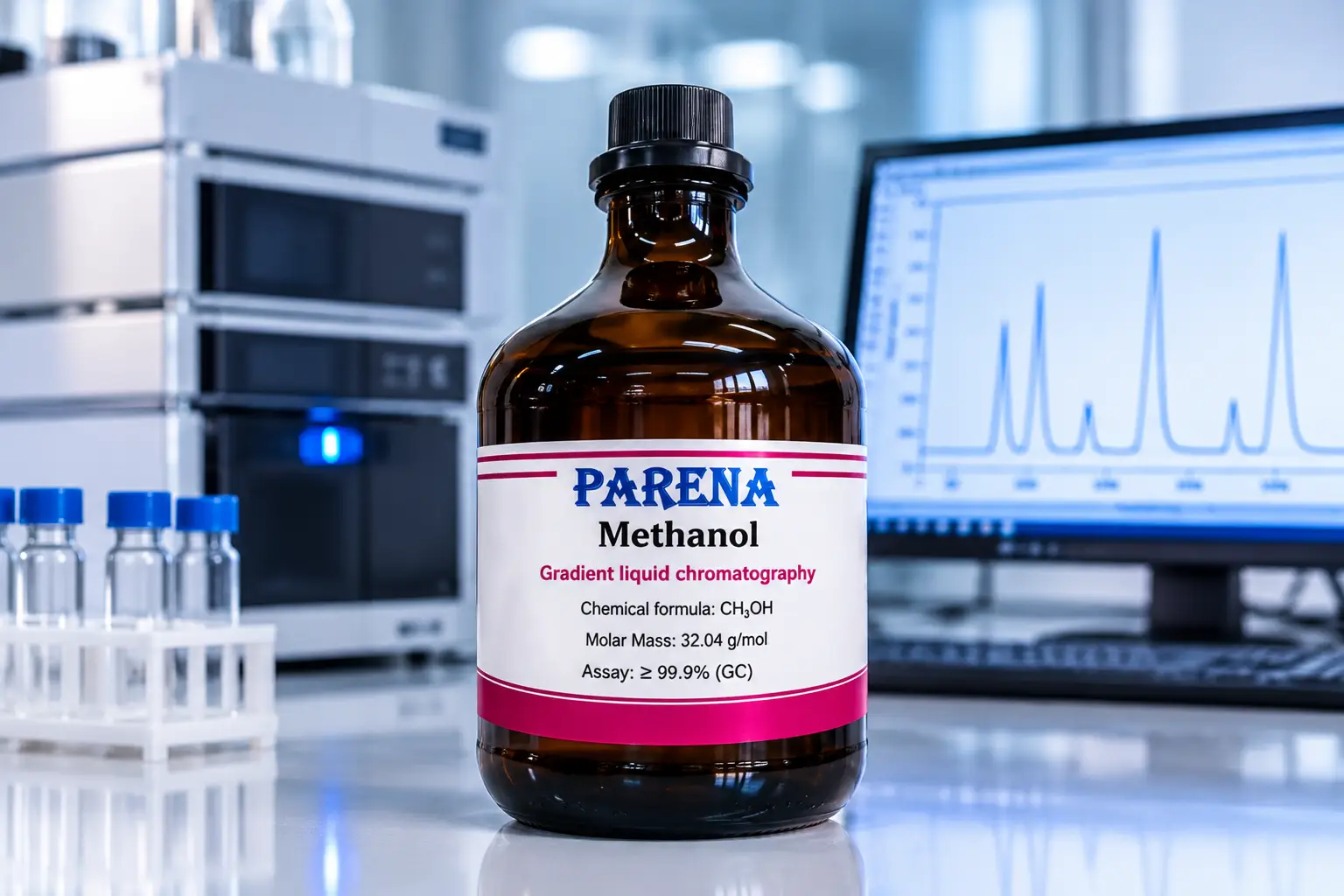
PARENA Methanol Gradient HPLC Grade
Methanol is one of the widely used organic solvents in liquid chromatography due to its polarity, miscibility with water, relatively suitable viscosity, and solvent properties. It is used in many chromatographic separation methods.
In Reversed-Phase HPLC methods, methanol acts as an organic modifier of the mobile phase. Increasing the proportion of methanol in the mobile phase generally increases its elution strength and may reduce the retention time of compounds. However, the magnitude and direction of its effect on separation depend on analyte structure, column type, mobile phase composition, and method conditions.
In Gradient HPLC Grade solvents, solvent quality control is particularly important for use in mobile phase composition programs. During gradient elution, a gradual or stepwise increase in methanol concentration may affect detector response and baseline behavior. UV-absorbing impurities in the solvent may appear as baseline changes, noise, or interfering signals when the solvent concentration changes during the gradient.
For this reason, solvents intended for Gradient LC are controlled not only for chemical purity but also for parameters such as UV absorbance, Gradient Elution testing, residue after evaporation, water content, and certain trace impurities. Acceptance limits for these parameters vary depending on the manufacturer, product, and test method.
In reversed-phase chromatography, the stationary phase usually has a relatively hydrophobic surface, such as C18, C8, or other bonded silica phases, while the mobile phase consists of water or an aqueous solution combined with an organic solvent.
Methanol, as the organic component of the mobile phase, affects the distribution equilibrium of analytes between the mobile and stationary phases. Increasing the methanol percentage in the mobile phase changes the interactions responsible for compound retention on the stationary phase and, in many RP-HPLC systems, reduces compound retention times.
Choosing methanol instead of other organic modifiers, including acetonitrile, may change selectivity, elution order, system pressure, peak shape, and resolution. Therefore, replacing methanol with acetonitrile or vice versa is not necessarily possible without changing the analytical method and usually requires evaluation and optimization of chromatographic conditions.
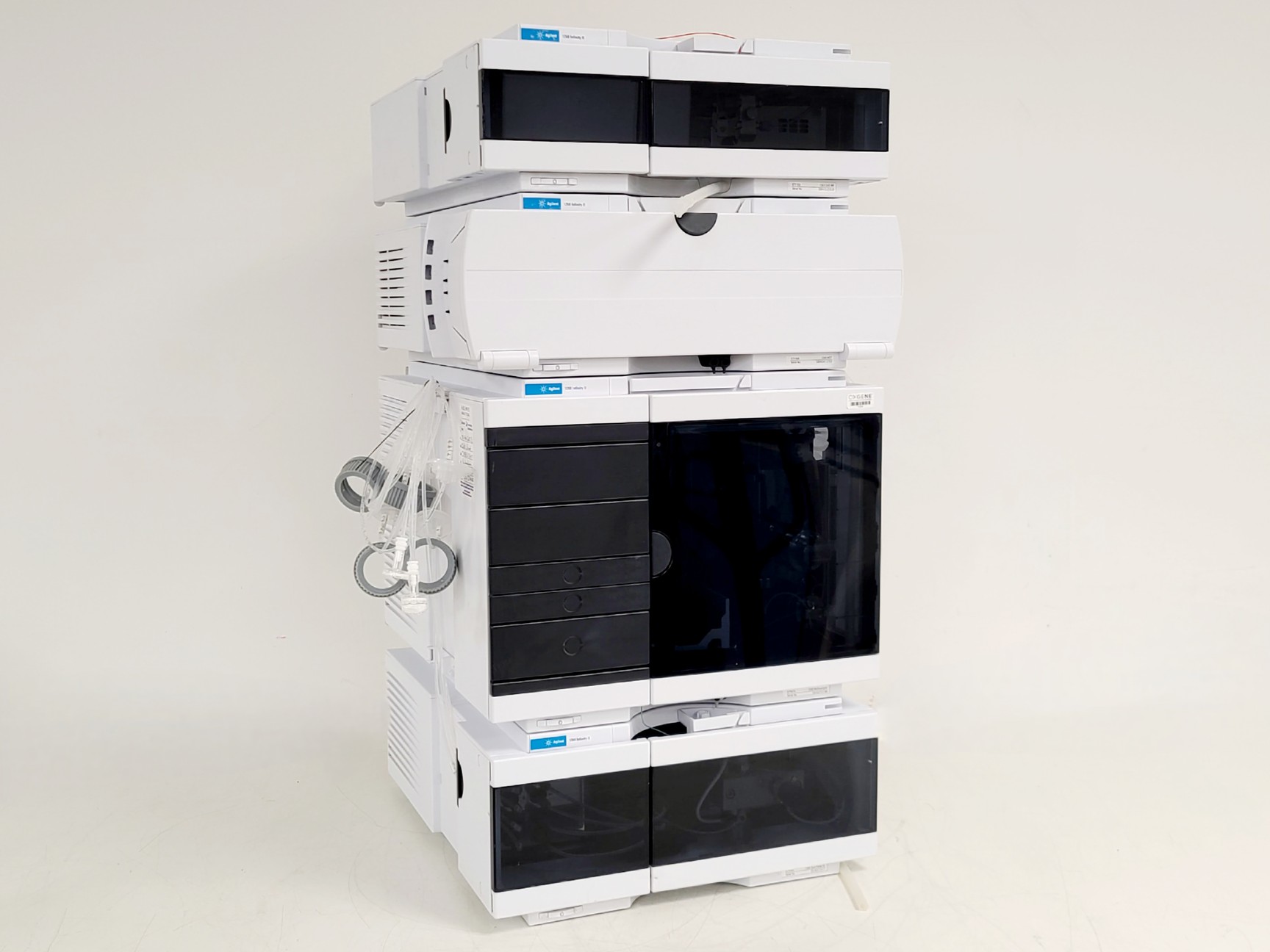
High-Performance Liquid Chromatography (HPLC) Instrument

Schematic illustration of the Gradient Elution process in HPLC
In an Isocratic method, the mobile phase composition remains constant throughout the analysis. In contrast, in a Gradient method, the proportions of mobile phase solvents change over time. This change in composition is used to separate mixtures containing compounds with different polarities, retention strengths, or retention times.
In gradient methods, the organic solvent quality must be compatible with changing mobile phase composition. Impurities that may have a limited effect under a constant mobile phase composition can cause baseline changes or interfering signals as the solvent percentage changes.
Key characteristics of Gradient HPLC solvents include:
1. Controlled UV Absorbance
UV-absorbing impurities in the solvent may increase background absorbance, reduce the signal-to-noise ratio, or produce unwanted signals at wavelengths used for analyte detection. UV absorbance control is particularly important in analyses performed at low wavelengths.
2. Controlled Solvent Behavior During Gradient Elution Testing
Gradient Elution testing is performed to evaluate signal or baseline changes under conditions where solvent composition changes. Suitable performance in this test is important for gradient methods that require a stable baseline.
3. Low Non-Volatile Residue
Residues remaining after solvent evaporation may cause contamination, deposits, or increased residual material in the chromatographic flow path. Control of Residue after Evaporation is important for sensitive applications.
4. Control of Water and Trace Impurities
Water content, unwanted organic compounds, and certain trace impurities may affect result reproducibility, mobile phase behavior, and method performance. The control limits for these parameters should be evaluated according to the product’s technical specifications.
Methanol is used as the organic component of the mobile phase in RP-HPLC methods, particularly in combination with water, aqueous solutions, and buffers compatible with the method. Adjusting the methanol percentage can be used to control retention time, optimize resolution, and adjust elution conditions.
In gradient elution methods, the percentage of methanol in the mobile phase changes according to the instrument’s programmed schedule. This approach is used for analyzing mixtures containing compounds with different polarities or retention strengths and may improve elution efficiency and reduce analysis time, depending on the method conditions.
Methanol Gradient HPLC is used in certain developed and validated methods for analyzing Active Pharmaceutical Ingredients (APIs), related impurities, degradation products, and compounds present in pharmaceutical formulations.
Its application in this field depends on the analytical method, column type, detector, sample solubility, and method requirements. Solvent grade selection is particularly important in methods sensitive to UV absorbance and impurity analysis.
In quality control laboratories, Methanol Gradient Grade may be used as a mobile phase solvent for evaluating composition, purity, impurities, and quality characteristics of chemical materials, provided that the analytical method has been designed or validated for use with this solvent.
In organic chemistry research, synthesis, process development, and quality control, methanol may be used for the separation and evaluation of organic compounds, reaction products, and certain related impurities.
In certain HPLC methods used to investigate compounds in biological samples, extracts, and research matrices, methanol is used as a mobile phase component or sample preparation solvent. Its application depends on the method, sample compatibility, and detector type.
Methanol is used in analytical method development to evaluate the effects of organic solvent type, solvent percentage, gradient slope, retention time, selectivity, and peak resolution. Compared with certain other organic solvents, changing the modifier type may significantly alter separation behavior.
Chromatography-grade methanol may be used in HPLC and certain UHPLC systems when its technical specifications are compatible with the analytical method and operating conditions. Solvent compatibility with operating pressure, column, equipment, method, and instrument conditions should be evaluated before use.
Different methanol grades vary in their intended applications, impurity limits, and quality control tests. Purity percentage alone is not a sufficient criterion for selecting a solvent for sensitive chromatographic applications.
| Methanol Grade | Main Application | Important Quality Control Characteristics | Suitability for HPLC |
|---|---|---|---|
| Industrial / Technical Grade | Industrial and process applications | Specifications appropriate for industrial use; impurity control depends on product specifications | Generally not a suitable choice for sensitive HPLC applications |
| Laboratory / Reagent Grade | General laboratory and chemical applications | General purity and testing appropriate for laboratory applications | Not necessarily suitable for HPLC |
| ACS Reagent Grade | General analytical applications according to applicable requirements | Compliance with ACS specifications, when declared and verified | Only when Suitability for LC is confirmed |
| HPLC Grade / Isocratic Grade | Liquid chromatography applications | Control of impurities and UV absorbance according to grade specifications | Suitable for LC methods according to product specifications |
| Gradient HPLC Grade | HPLC methods involving changes in mobile phase composition | UV absorbance, gradient testing, impurities, and residue control according to specifications | Specialized choice for gradient methods |
| LC-MS Grade | Liquid chromatography coupled with mass spectrometry | Control of impurities affecting MS response, including certain ionic and background contaminants | Suitable for LC-MS methods according to specifications; generally also usable for LC-UV, but not necessarily the best or most economical choice |
Methanol ACS Reagent Grade is supplied for general analytical and laboratory applications according to the applicable ACS grade specifications. However, ACS compliance alone does not guarantee solvent performance in gradient HPLC methods.
In HPLC, UV-absorbing impurities may cause increased noise, baseline changes, or interfering signals during changes in mobile phase composition, even at low concentrations. Therefore, for sensitive chromatographic methods, LC-grade solvents with controlled UV absorbance specifications and chromatographic testing are generally more suitable than general-purpose ACS solvents, unless the ACS product is specifically confirmed as suitable for LC applications.
LC-suitable grades may differ in their quality control tests and acceptance limits. Gradient Grade solvents are specifically relevant for methods in which mobile phase composition changes over time, particularly with regard to parameters such as Gradient Elution testing and UV absorbance.
In Isocratic methods, the mobile phase composition remains constant throughout the analysis. In gradient methods, changes in solvent proportions may reveal UV-absorbing impurities through baseline changes. Therefore, using a solvent with appropriate Gradient LC specifications is recommended for gradient methods and sensitive analyses.
LC-MS Grade solvents are intended for liquid chromatography coupled with mass spectrometry. In addition to chromatographic quality, they focus on controlling impurities that may increase background signals, contaminate the ion source, or interfere with mass spectrometric response.
Gradient HPLC Grade solvents are specifically selected for chromatographic requirements and solvent behavior during gradient tests. LC-MS Grade is a more specialized choice for methods where mass spectrometer sensitivity and background contamination control are important.
Therefore, Gradient HPLC and LC-MS Grade should not be compared solely based on purity percentage. Selection should be based on detector type, analytical method, and the actual product specifications.
| Specification | Value / Description |
|---|---|
| Product Name | Methanol HPLC Grade |
| Brand | PARENA |
| Product Code | M103G |
| Grade | Gradient Liquid Chromatography |
| Chemical Formula | CH₃OH |
| CAS Number | 67-56-1 |
| Molar Mass | 32.04 g/mol |
| Synonyms | Methanol, Methyl Alcohol, Carbinol, Hydroxymethane |
| Physical State | Liquid |
| Color | Colorless |
| Melting Point | Approximately −97.6 °C |
| Boiling Point | Approximately 64.7 °C |
| Density | Approximately 0.792 g/mL at 20 °C |
| Miscibility with Water | Miscible in all proportions |
| Main Application | Organic mobile phase solvent in HPLC |
| Specialized Applications | Gradient Elution, RP-HPLC, and chromatographic method development |
| Packaging | 1 L, 2.5 L, 20 L |
In chromatographic analyses, solvent quality may affect method performance alongside column type, flow conditions, mobile phase composition, and detector type. Using a solvent with specifications suitable for LC may reduce the likelihood of introducing certain interfering impurities through the mobile phase.
Quality control becomes more important in gradient methods because changes in the percentage of organic solvent during the analytical program may reveal background absorbance changes caused by solvent impurities. This is particularly relevant in UV measurements, impurity analysis, and methods requiring a stable baseline.
From a solvent selection perspective, parameters such as UV absorbance at the analytical wavelength, Gradient Elution testing, non-volatile residue, and water content should be matched to the requirements of the analytical method.
Methanol is a highly flammable and toxic liquid. Contact, inhalation, or ingestion may cause serious poisoning. Exposure to methanol may damage the central nervous system, vision, and other organs.
When working with Methanol Gradient HPLC:
Hazard classification, GHS symbols, and emergency measures should be reviewed according to the official product SDS.
Methanol Gradient HPLC should be stored in its original, tightly closed container in a suitable chemical storage area with adequate ventilation and away from ignition sources.
To maintain solvent quality:
PARENA Methanol Gradient HPLC, product code M103G, is available in the following packaging sizes:
The packaging size should be selected based on laboratory consumption, analysis frequency, mobile phase preparation requirements, and storage conditions.
PARENA Methanol Gradient HPLC, product code M103G, is an option for instrumental analysis laboratories, quality control laboratories, chemical research, and liquid chromatography methods, provided that the product specifications meet the requirements of the analytical method.
When purchasing Methanol Gradient HPLC, in addition to purity percentage, chromatographic specifications such as UV absorbance, Gradient Elution testing, non-volatile residue, water content, and other impurity limits should be considered.
To inquire about the price of PARENA Methanol Gradient HPLC, check availability, select a packaging size, or request technical documentation, use the product price inquiry section. For information about other chemical supply products and services, visit the Noavaran Fidar Shimi Polymer Gostar website.
Product Name: Methanol Gradient Grade for HPLC
Brand: PARENA
Product Code: M103G
Grade: Gradient Liquid Chromatography
CAS: 67-56-1
Packaging: 1 L, 2.5 L, 20 L
For general chemical information about this compound, visit the Methanol page on PubChem.
