
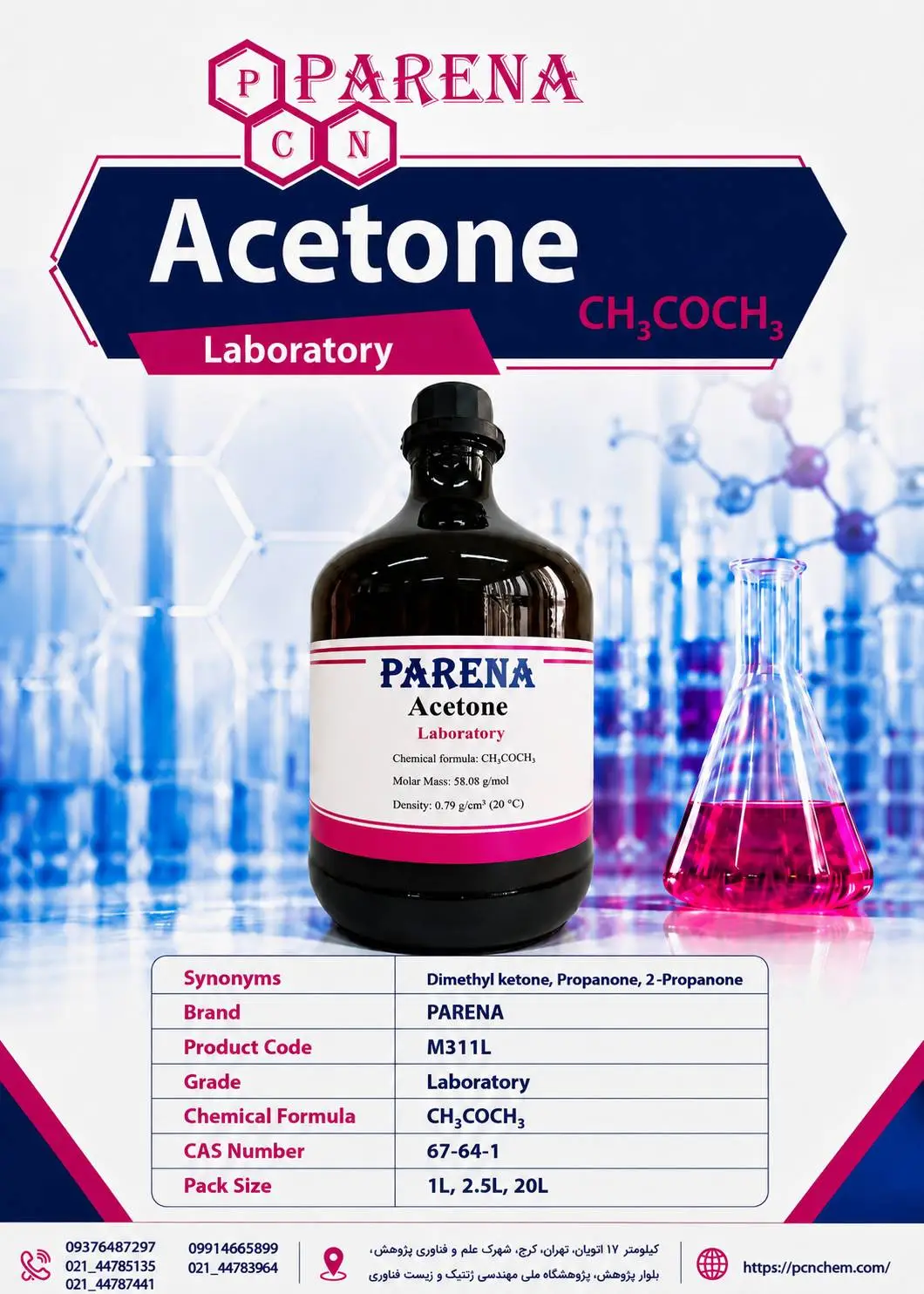
Acetone Laboratory, CAS Number 67-64-1, is a widely used chemical solvent in laboratories, research centers, and various industries. It is commonly used for sample preparation, equipment cleaning, and degreasing processes.
To inquire about the price of Acetone Laboratory, product availability, packaging sizes, and purchasing conditions, please use the price inquiry section on this page or contact the sales team at Novavaran Fidar Shimi Polymer Gostar.
Novavaran Fidar Shimi Polymer Gostar supplies Acetone Laboratory grade for laboratories, quality control departments, research centers, and businesses operating in the chemical industry. Based on its stated technical specifications, this product can be evaluated for laboratory applications according to the user’s requirements. To buy laboratory-grade acetone and inquire about its price, availability, packaging sizes, and supply conditions, you can submit a request through the price inquiry section on this product page.
Acetone is an organic compound belonging to the ketone family. It is also known as 2-Propanone and Propanone, with the chemical formula C₃H₆O and CAS Number 67-64-1. It is a clear, colorless, volatile liquid that is miscible with water and dissolves many organic compounds.
Laboratory acetone is used in certain chemical tests, research activities, and sample preparation procedures. The Laboratory grade refers to the designated application category of the product. However, the exact purity percentage and impurity limits should be verified using the manufacturer’s specifications or the product’s Certificate of Analysis (COA).
When selecting and purchasing Acetone Laboratory, it is important to ensure that the product’s technical properties meet the requirements of the intended experiment, method sensitivity, and quality standards.
Acetone is primarily manufactured on an industrial scale through the cumene process. In this process, benzene and propylene initially react to form cumene. The cumene is then oxidized with oxygen to produce cumene hydroperoxide. In the final stage, this compound decomposes to produce phenol and acetone.
Overall reaction of the final stage:
C₆H₅CH(CH₃)₂ + O₂ → C₆H₅OH + CH₃COCH₃
Cumene + Oxygen → Phenol + Acetone
The resulting acetone may undergo separation and purification processes, including distillation, depending on the required product specifications. The characteristics of the final product depend on the manufacturing process, purification conditions, and the manufacturer’s quality control standards. Therefore, the Laboratory grade designation alone does not indicate a specific purity percentage. The product’s technical documentation should be reviewed to determine its actual purity.
Due to its solvent power, volatility, and miscibility with water, acetone is used in various laboratory and research applications. Its main uses include:
Selecting the appropriate grade depends on application sensitivity, operating procedures, permitted impurity limits, and the product’s technical specifications. Laboratory grade is not necessarily suitable for every sensitive test or specialized analytical method.
| Specification | Value / Description |
|---|---|
| Chemical Name | Acetone |
| Common Name | Acetone |
| Grade | Laboratory |
| Alternative Chemical Name | 2-Propanone |
| CAS Number | 67-64-1 |
| Chemical Formula | C₃H₆O or CH₃COCH₃ |
| Molecular Weight | 58.08 g/mol |
| Physical State | Liquid |
| Appearance | Clear and colorless |
| Melting Point | Approximately -95 °C |
| Boiling Point | Approximately 56 °C |
| Density | Approximately 0.79 g/cm³ at around 20 °C |
| Water Solubility | Miscible |
| Key Safety Characteristic | Highly flammable liquid |
The values in this table represent the general properties of acetone and do not replace the specific technical specifications of the supplied product. For information about purity, impurity limits, and other quality characteristics, refer to the product’s technical data sheet or Certificate of Analysis.
For general chemical information about acetone, visit the Acetone page on PubChem.
The performance of acetone depends on the material involved, process conditions, application method, and compatibility with the intended materials and surfaces.
Acetone is a highly flammable liquid, and its vapors can form flammable mixtures with air. Before use, read the product’s Safety Data Sheet (SDS) and follow all applicable workplace safety procedures.
To ensure proper storage of acetone, observe the following recommendations:
Acetone packaging must be suitable for the chemical properties of the solvent and the requirements for storing and transporting flammable materials. Before placing an order, check the packaging size, technical specifications, and accompanying product documentation. Available packaging sizes, stock status, and supply conditions should be confirmed with the sales team.
When purchasing laboratory acetone, it is important to review the product grade, stated purity, impurity limits, intended application, and technical documentation. Matching these specifications with the requirements of your laboratory, quality control department, or research center helps ensure that the selected product is suitable for its intended use.
Novavaran Fidar Shimi Polymer Gostar provides the opportunity to submit inquiries regarding the supply conditions of this product. To learn more about the company, visit the Novavaran Fidar Shimi Polymer Gostar official website.
To obtain information about the laboratory acetone price, availability, technical specifications, packaging sizes, and purchasing conditions, submit your request through the price inquiry section on this page or contact the sales team at Novavaran Fidar Shimi Polymer Gostar.
Acetone Laboratory is an organic solvent used in various laboratory applications. Its purity level and impurity limits should be verified through the manufacturer’s technical specifications or Certificate of Analysis.
This chemical is used in selected laboratory tests, sample preparation, quality control, organic chemistry research, extraction procedures, and cleaning compatible equipment.
The CAS Number of acetone is 67-64-1.
The product grade, stated purity, impurity limits, intended application, packaging size, and technical documentation are among the most important factors to check before purchasing.
The price of Acetone Laboratory depends on product specifications, packaging size, availability, and supply conditions. To receive up-to-date pricing information, submit a request through the product page’s price inquiry section.
